Features of the Emirate of Dubai for Geoanalytics and Real Estate Selection
This blog article is for informational and educational purposes only, to raise awareness among real estate agents and prospective investors in the economy of the Emirate of Dubai, UAE.
Introduction
In practice, choosing real estate in Dubai is a complex task that requires knowledge of the region's specifics. Smart Indexes presents an article to begin your acquaintance with the regional specifics of the Emirate of Dubai, UAE.
Structure of the Emirate of Dubai
The administrative and territorial structure of the Emirate of Dubai is presented by the following hierarchical model:
-
The Emirate of Dubai — 1 of 7 Emirates of the UAE.
Located on the southeastern coast of the Persian Gulf, territorially between the emirates of Abu Dhabi and Sharjah.
-
A total of 9 sectors of the administrative division of Dubai.
The sectors border each other and form a top-level grouping of communities for visibility, including on the map.
Each of the sectors has a specific functional purpose for the life of the Emirate of Dubai.
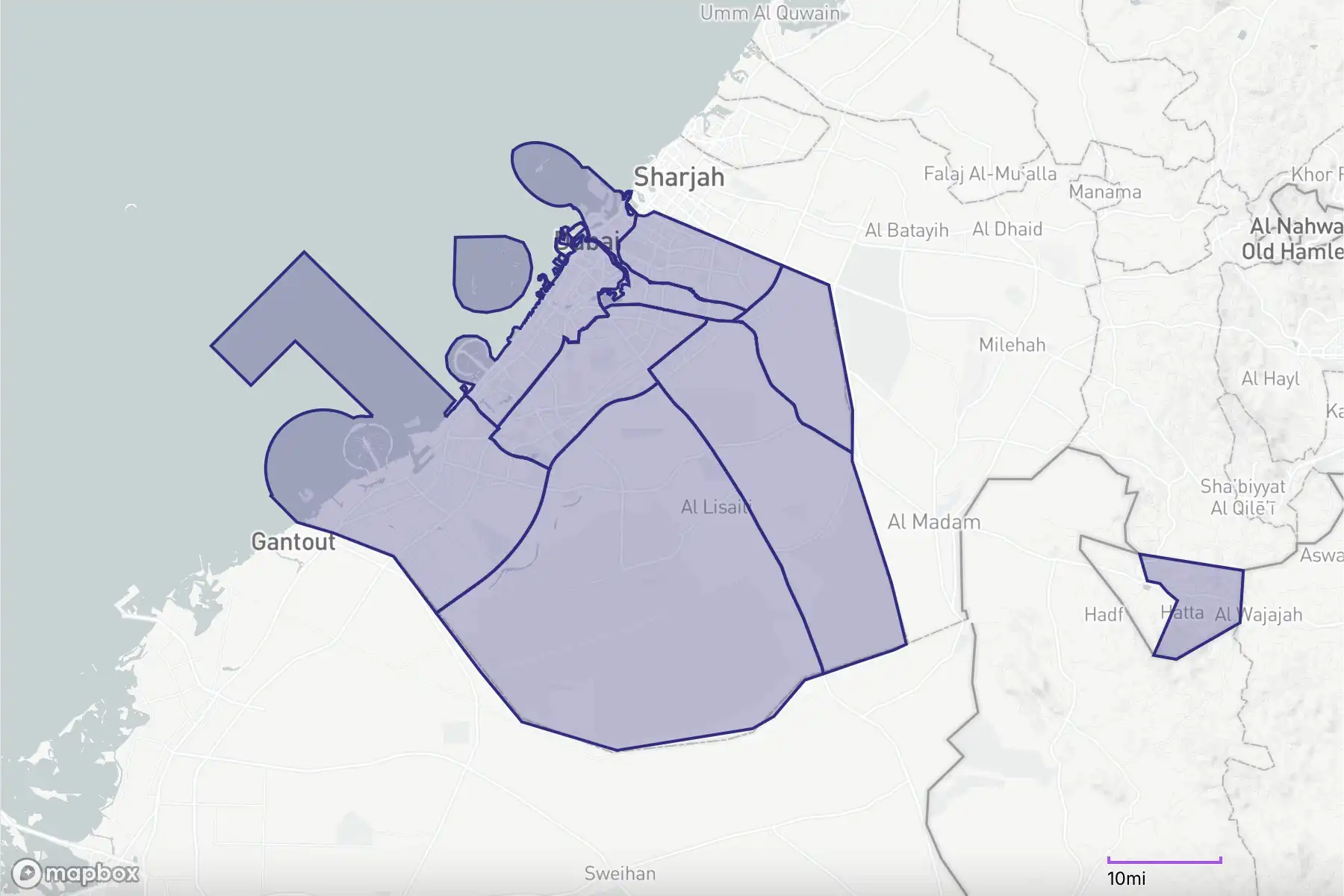 Sectors of the Emirate of Dubai, UAE
-
There are 222 communities in Dubai.
Each of the sectors is territorially located as a group of adjacent communities.
Each community has an official name in English and Arabic.
-
There are a total of 148 development master projects in various stages of construction in a number of Dubai's developing communities.
.webp) Web interface of the interactive geoanalytical map Smart Indexes for master projects of the Emirate of Dubai
Web interface of the interactive geoanalytical map Smart Indexes for master projects of the Emirate of Dubai
-
The following are registered in the Emirate of Dubai:
- more than 104,000 buildings,
- of which 2 400+ are commercial development projects and have project names in English and Arabic.
Buildings in Dubai are characterized by the following key features.
- Availability of Makani Number for navigation to the entrances of buildings.
- Full characteristics of each registered building in the Building Summary dataset (Dubai Pulse, DLD).
Including:
- Indications of the presence of parking, elevators, air conditioning area, etc.
- Information about the master developer: licenses, partner bank (escrow agent), etc.
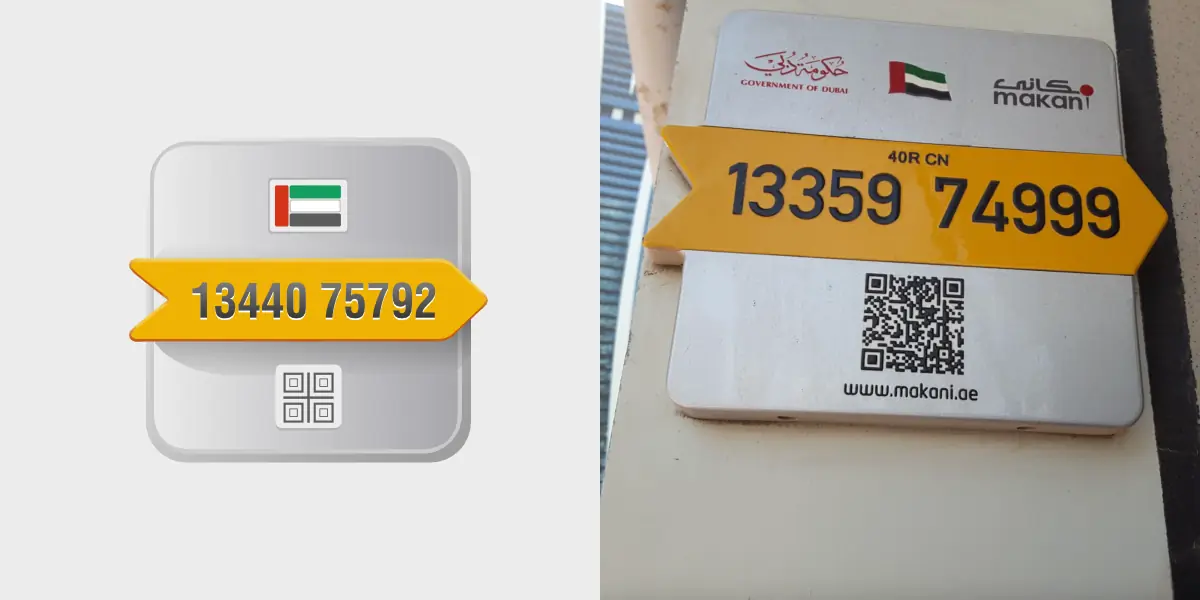 Example of a sign with Makani Number on the building facade
Solving these problems
- Developers API includes a summary of data and reputation rating for each of the registered master developers.
- Dubai's Master Projects of Development Map filtered by year of completion.
- Dubai Emirate Population Map includes all communities: their characteristics and population (including population density).
Renaming administrative geographic objects
In January 2024, the Dubai Land Department (DLD) launched a project to rename 28 key communities in Dubai. The initiative is part of a larger program to update the names of communities and align them with Dubai's identity.
Notable changes include the renaming of the area around Sheikh Zayed Road to Burj Khalifa, as well as rebranding of parts of Emirates Hills, Motor City, and Sports City.
| Area Code | Old Name | New Name |
|---|---|---|
| 284 | Al Khawaneej Third | Al Ttay |
| 384 | Al Medhmar | AL ThanyahSecond |
| 321 | Al Mina | Madinat Dubai Al Melaheyah |
| 383 | Al Safouh Third | Al Thanyah First |
| 312 | Al Suq Al Kabeer (Dubai) | Al Souq Al Kabeer |
| 531 | Dubai Industrial City First | Saih Shuaib 2 |
| 532 | Dubai Industrial City Second | Saih Shuaib 3 |
| 533 | Dubai Industrial City Third | Saih Shuaib 4 |
| 393 | Emirates Hills First | Al Thanyah Fifth |
| 388 | Emirates Hills Second | Al Thanyah Third |
| 394 | Emirates Hills Third | Al Thanyah Fourth |
| 412 | Festival City Second | Al Kheeran |
| 683 | Golf City | Al Hebiah Fifth |
| 599 | Jabal Ali Industrial | Jabal Ali Industrial First |
| 591 | Jebel Ali Village | Jabal Ali First |
| 681 | Jumairah Village First | Al Barsha South Fourth |
| 684 | Jumairah Village Second | Al Barsha South Fifth |
Important to consider
- For structural analysis of the real estate market for the purpose of rational selection of real estate taking into account changes in the names of administrative-territorial geo-objects in the Emirate of Dubai,
- For precise work with various sources to exclude inaccuracies in the choice of area.
Solution to this problem
Makani Search API includes fields of similar names of communities, master projects, free zones, as well as their abbreviations and obsolete names for semantically complete search by geoobjects of the Emirate of Dubai.
Measurement system in the Emirate of Dubai
Official sources of Dubai Land Department use the metric system of measurement:
- Area of real estate (units) - square meters.
- Area of plots - square meters.
- Area of communities and master projects - square km.
- Population density - people/sq. km, etc.
National currency - dirhams (AED), used in value indicators in official sources of Dubai Land Department (DLD).
Solution to this problem
Property Price Indexes API includes indices of prices per square meter for sale and rent of real estate in AED and USD, as well as the capitalization rate Cap Rate differentiated for residential and commercial real estate.
Incompleteness and heterogeneity of data in open sources Dubai Pulse
The official source Dubai Pulse provides access to more than 1,000 datasets on the work of economic sectors and life activities of the Emirate of Dubai. But, for example, for warehouses in Building Summary there is no complete data on the total and usable area of all objects used as warehouses or warehouse units, which can create difficulties in a full analysis.
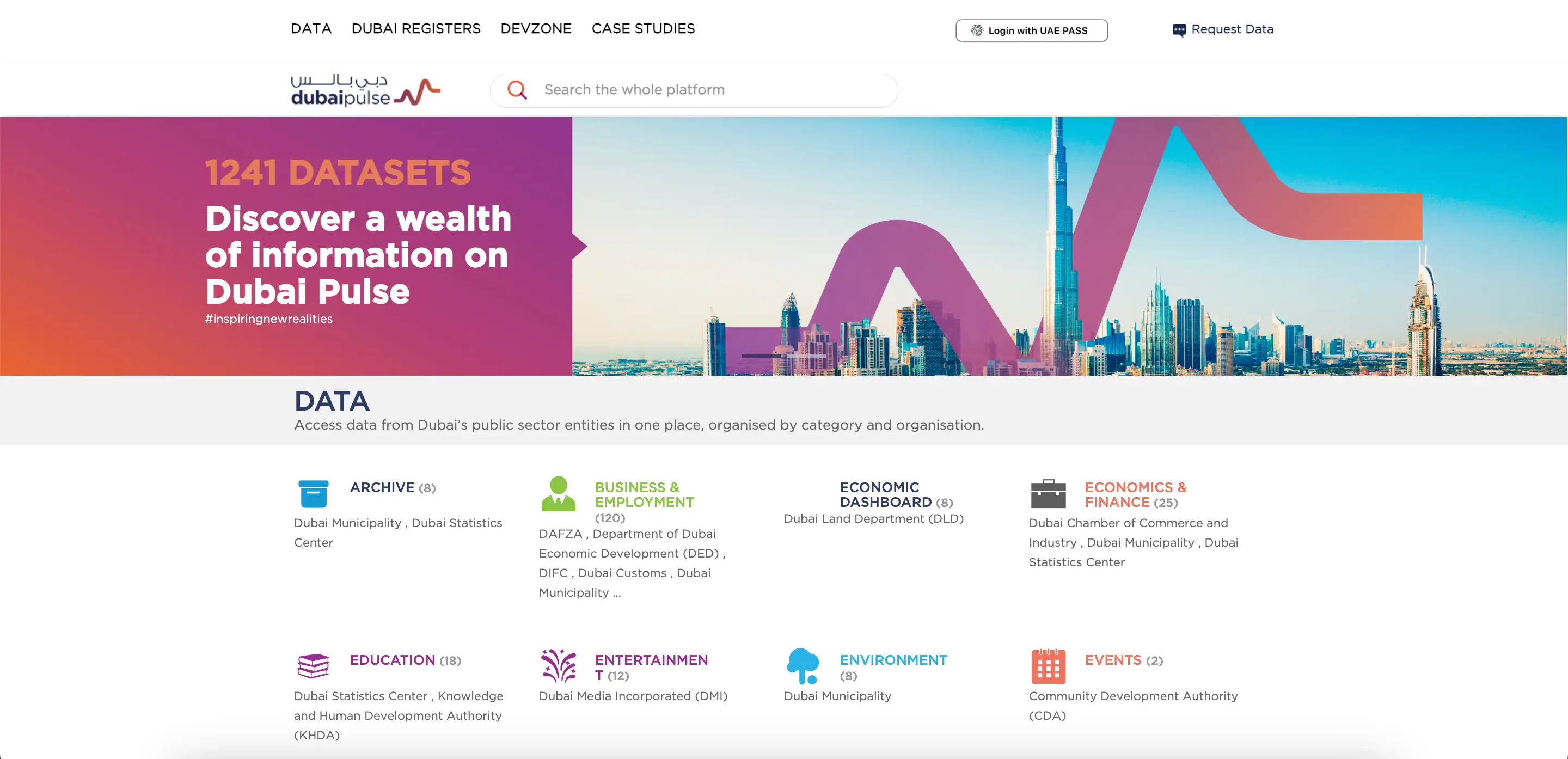 Official Open Data Bank of the Emirates Dubai — Dubai Pulse
Community names may be written differently in official datasets, probably due to the lack of a single state database of address index used in all departments of the Emirate.
Solution to this problem
For a complete data selection for analytical research of the Dubai real estate market, Smart Indexes uses detailed and constantly updated dictionaries of correspondences taking into account the renaming of geo-objects (hashmaps).
Vacant area assessment
Open Data Dubai Pulse is not the primary source for an accurate assessment of vacant areas — otherwise there would be a separate dataset. The Real Estate Regulatory Authority (RERA), which is part of the DLD, is engaged in the registration and regulation of transactions in Dubai, but unlike the Russian Rosreestr, does not publish an open register of areas and transaction histories.
The Ejari (RERA) system manages rentcontracts, but does not provide detailed data on areas and transactions in the public domain. Full access to such data is usually only available to licensed professionals or organizations with a paid subscription and permissions from RERA/DLD.
If accurate data on areas and transactions is required, it may be necessary to work with a licensed property management company or access DLD's paid API services.
Floor structure of high-rise buildings in Dubai
The following floor structure applies to high-rise buildings in the Emirate of Dubai. This is also important to consider when choosing properties in residential and commercial buildings.
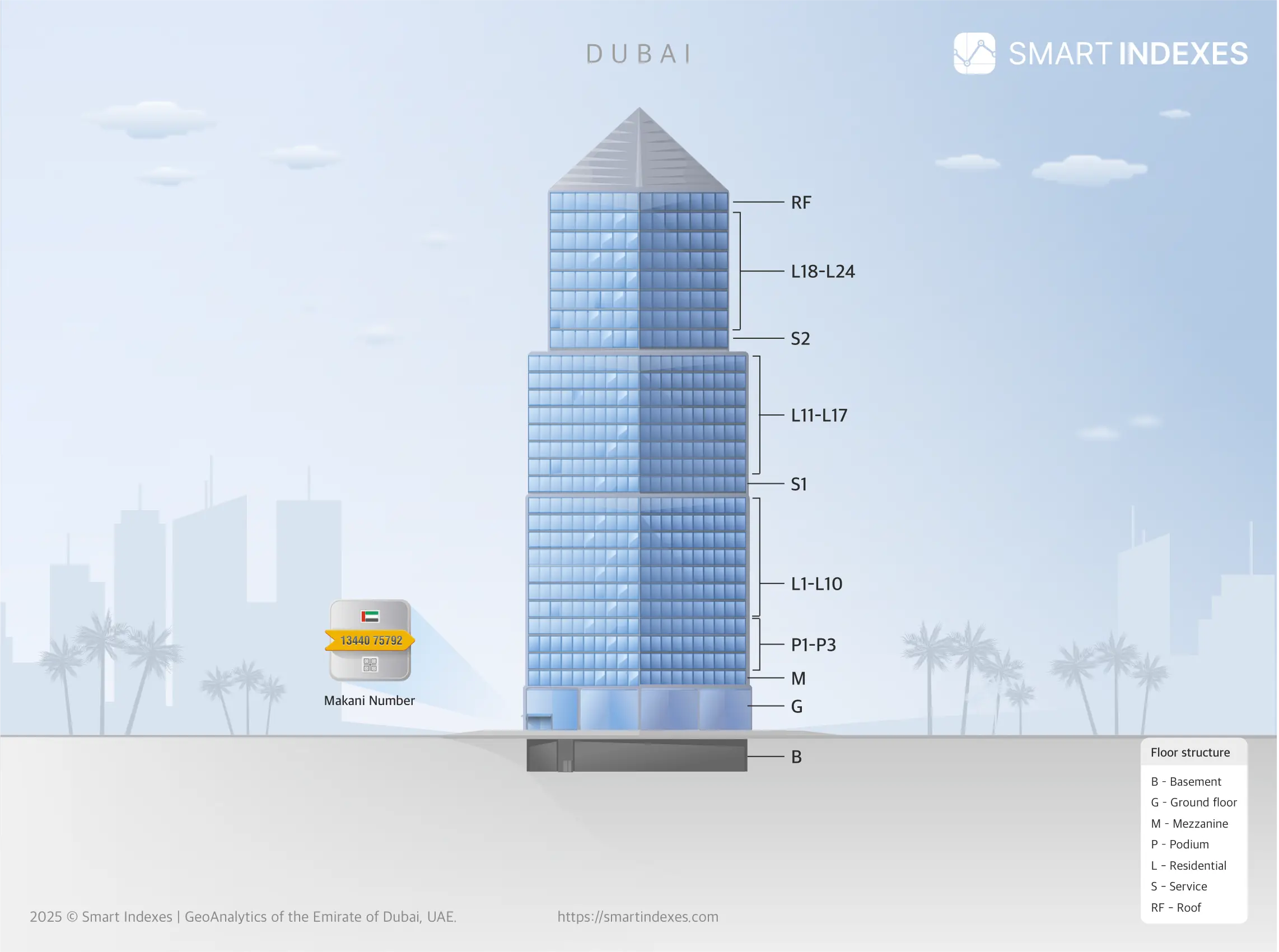 Floor structure in high-rise buildings
B (short for Basement) is an underground floor used for utility rooms and parking.
In buildings with multiple underground levels, the numbering goes down. The level closest to the ground is B1, then B2, and so on.
G (short for Ground floor) is the first floor, located at ground level. Typically, the ground floor of a residential building contains a lobby with a reception area.
M (short for Mezzanine) is a "half-story", a small technical floor that is located between two main floors, such as the first and second floors, but not necessarily. Often not numbered separately, only marked "M".
P (short for Podium) is an architectural pedestal, a platform that provides stability to a building.
Extends beyond its area on one or more sides and may consist of several levels. If there are five in the example, the marking is "5P".
Inside there may be both apartments and common facilities, such as a gym. The roof of the podium usually contains swimming pools and recreation areas.
1–37 Levels are the typical floors of the tower.
They usually have repeating layouts, with the exception of penthouses on the upper floors.
If the roof is exploitable, it may contain an infinity pool, garden, and lounge.
Example #1
building_floor_height: G +9M +10 +3P +12R
In the official dataset Buildings Summary in the open data platform Dubai Pulse, floor designations have the following meaning:
- G — Ground floor (first floor or ground level).
- M — Mezzanine floor (interfloor space between the main floors, often used for shops, offices, etc.).
- P — Podium floor (usually underground or multi-level parking).
- R — Roof (roof).
The numbers in the building indication indicate the number of floors or levels above/below these main levels:
- +9M — 9 floors above the Mezzanine.
- +10 — 10 regular floors above the Ground floor.
- +3P — 3 podium floors.
- +12R — 12 floors to the roof or roof structure.
Example #2
building_floor_height: 4B+ G +85 +1P +2R
The notation building_floor_height: 4B+ G +85 +1P +2R can be deciphered as follows:
- 4B — 4 underground floors (B = Basement), usually used for parking, technical rooms or warehouses.
- G — Ground floor (first floor at ground level).
- +85 — 85 floors above the Ground floor.
- +1P — 1 podium floor (Podium), which may include parking, retail space or other public areas.
- +2R — 2 roof levels (Roof), this may include technical floors or other structures on the roof.
Example #2 — this building includes 4 underground levels, the first floor at ground level, 85 floors above it, 1 podium floor and 2 roof levels.
Read more in Knowledge Base — article «Floor structure in high-rise buildings».
Conclusions
The Emirate of Dubai is developing at a rapid pace both in the development sphere, using proven global technologies and practices (best practice methodology), and in particular in the field of real estate technologies (proptech).
The Smart Indexes team recommends studying the official development strategy of the Emirate of Dubai, published in the format of an open PDF document Executive Master Plan 2040.
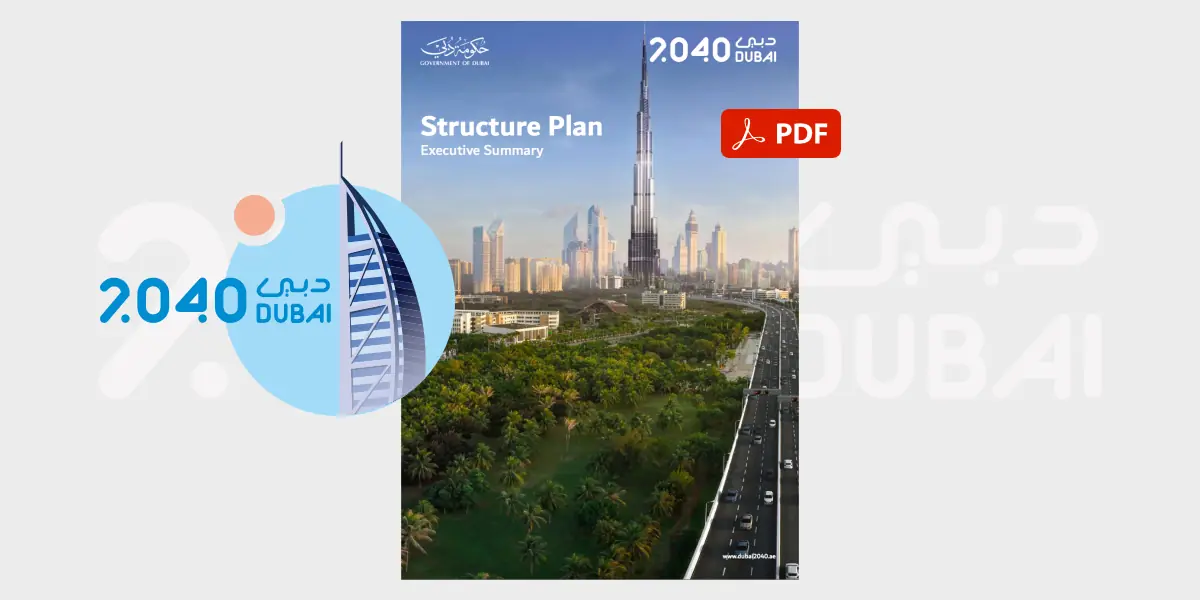 Executive Master Plan 2040
Geoanalytics cases, presented on the Smart Indexes website, are aimed to help real estate agents and potential investors explore the dynamic development markets and urban infrastructure of the Emirate of Dubai.
The government provides ample opportunities for starting a business through special economic zones and investing in the economy as part of the Dubai 2040 strategy.
Subscribe to our Telegram channel and stay up to date with Smart Indexes updates.
Subscribe

