
Dubai Emirate Population by Communities
This use case explores the population distribution of the Dubai Emirate across all administrative communities and calculates population density (people/km²) for each area based on verified official data.
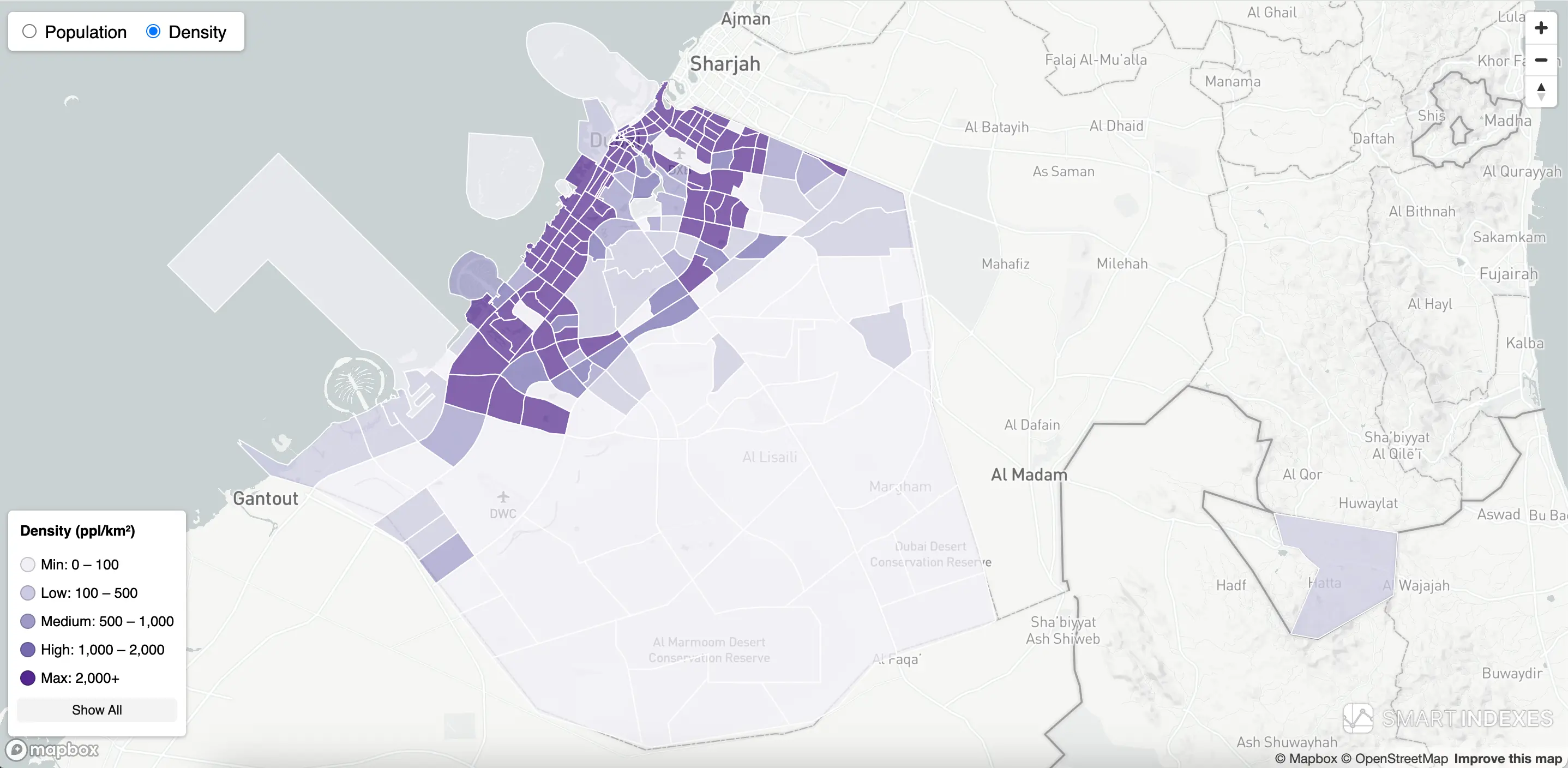 Population map of Dubai communities.
Research Objective
To analyze how the population of Dubai Emirate is distributed across all communities within defined administrative boundaries.
Task Definition
The initial task is to evaluate and visually rank all 221 Dubai communities on the map by two key indicators:
- Total population per community;
- Population density (people per km²).
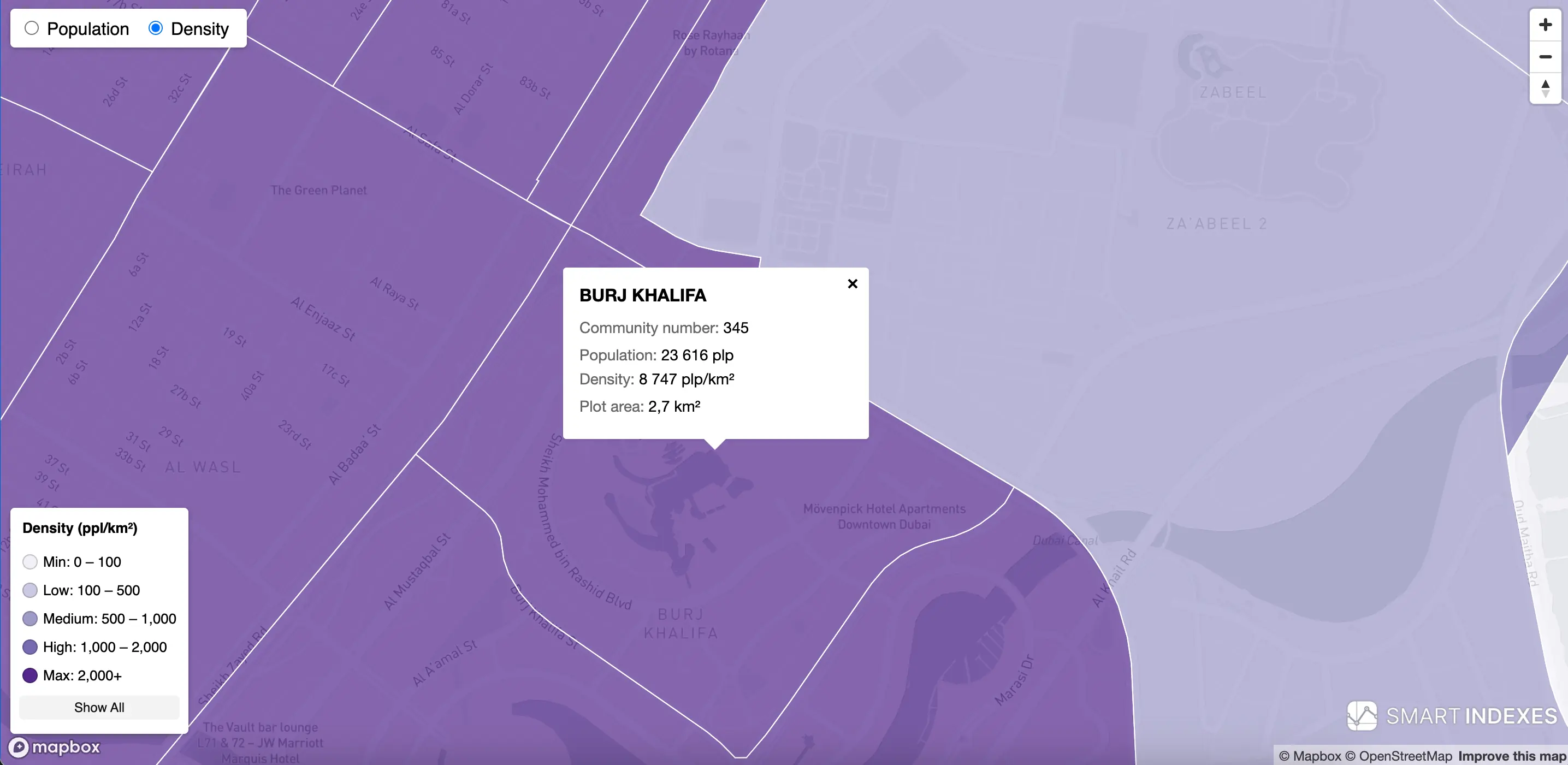 Burj Khalifa community selected on the geoanalytical map.
Population: 23,616 residents. Density: 8,747 people/km²
Requirements
- Use only official and verified population data for the Dubai Emirate.
- Ensure population density is calculated precisely as residents per km².
- Communities must be ranked by color scale from minimum to maximum with a switch between population and density views.
- Area calculations must rely on official data for accurate density computation.
 Cover fragment of the Population Bulletin of Emirate Dubai PDF.
Solution
The Smart Indexes team implemented the solution as follows:
- Collected population data from the official bulletin "Population Bulletin of Emirate Dubai"
(source: Dubai Statistics Center). - Extracted area sizes from the Community.kml file (from Dubai Pulse) and converted them to km².
- Merged datasets by community number.
- Calculated population density using:
density = ROUND(population / plot_area_sq_km) - Prepared final dataset with: community ID, name, population, area in km², and density.
- Visualized data via Leaflet/Mapbox using color segmentation and metric toggling.
Note:
- ESRI, creator of ArcGIS, is an official partner of GeoDubai and supplies geospatial data to government projects in Dubai Emirate.
- Official Dubai documents use metric units:
- Communities — in km²
- Real estate units (apartments, offices, etc.) — in m²
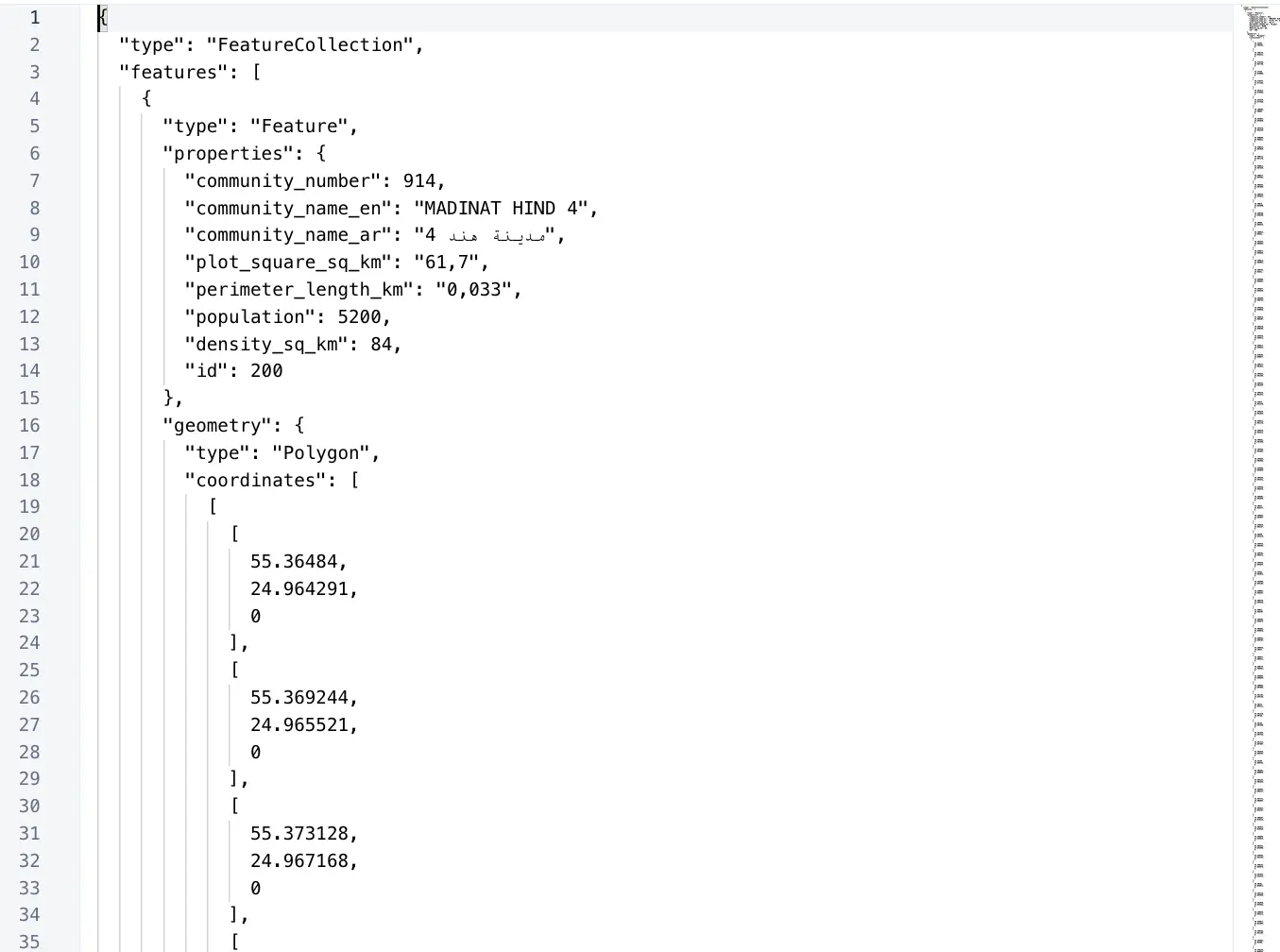 Example row from the final dataset: Community 914, MADINAT HIND 4, population: 5,200, area: 61.7 km², density: 84 people/km².
Answers to related questions
How to correctly calculate the population density for the communities of the Emirate of Dubai
The above solution sequence shows the formula for population density as the population of the community (total residents in the community) in relation to the area of the plot (administrative boundaries) of this community.
We interpret this formula as a general estimate: how many residents live conditionally on 1 sq. km of the area of the community.
The urban relief of the Emirate of Dubai is highly differentiated by the types of buildings: skyscrapers (towers), villas (villa), apartment buildings (commonhold properties) and other objects.
Natural and labor migration create certain difficulties in the accuracy of calculating all residents actually living in each of the communities, but using registration data on rent (rent contracts).
Is an individual renting a house considered a resident real estate unit in Dubai for example 6 months and is he/she counted as a resident in Dubai population statistics?
When renting a property for more than 90 days, a valid residence visa and Emirates ID are required. Without them, it is impossible to register a rent contract in the Ejari system.
Dubai Statistics Center forms an assessment of "permanent residents" - both UAE citizens and foreigners who have a valid residence permit and are registered in the unified Population Register of the Federal Authority for Identity, Citizenship and Residency. This category includes all those who actually reside in the emirate on a permanent basis, including representatives of labor migrants.
According to international recommendations of the UN (United Nations DESA), a "usual residence" (usual residence) is considered to be an object where a person has lived continuously for at least six months and one day or intended to live for at least six months during the year.
Therefore, if an individual rents a unit in Dubai for a period of at least six months and has a valid residence permit, then he/she is recognized as a permanent resident and is included in the official demographic statistics of the Emirate.
If he/she rents housing without a residence visa (for example, on a tourist, guest or other short-term visa), then the Government of Dubai does not recognize his/her person as a resident of the UAE, and such a lease is not included in the number of "permanent residents" in Dubai population statistics.
Bottom line: with a visa and Emirates ID, tenants for ≥ 6 months are included in official statistics; without a visa, they are not.
Result
The interactive map "Dubai Emirate Population by Communities" allows users to:
- Identify communities with the largest number of residents.
- Find communities with highest population density.
- Switch metrics in real time for comparative analysis.
- Get clear visual segmentation of population and density ranked from min to max.
Recommendation of Smart Indexes
For more detailed segmentation of population and density within master communities and individual buildings, it is recommended to use data from EJARI — the official rental contract registry in Dubai. This is particularly relevant given the high rate of labor migration in the emirate. More accurate insights can be achieved by analyzing occupancy data of real estate units and additional external sources.
Demo Map
To access the interactive map demo with polygonal Mapbox data, please contact Smart Indexes experts.
Subscribe to our Telegram channel and stay up to date with Smart Indexes updates.
Subscribe